
“It was said of John Hartt that he was put off the train at Rawlins because that was as far as his available money would take him. He settled down to amass a fortune . . . John’s winter range was on Sand Creek, Hiawatha, and Powder Springs west of Baggs, Wyoming. He summered on the Little Snake River and tributaries” (4).
Hartt started his ranching career working for a variety of outfits in southern Wyoming (5). Specifically, he worked for an outfit called the King Brothers from 1894 until 1901 (6) making $30 a month (72). Hartt also was noted to work for a rancher named Ora Haley early in his career. This was during the time Haley was just getting his start in the cattle industry on the Laramie Plains (7). Hartt is known for being “thoroughly acquainted with every phase of the stock-raising industry,” including both cattle and sheep (8).
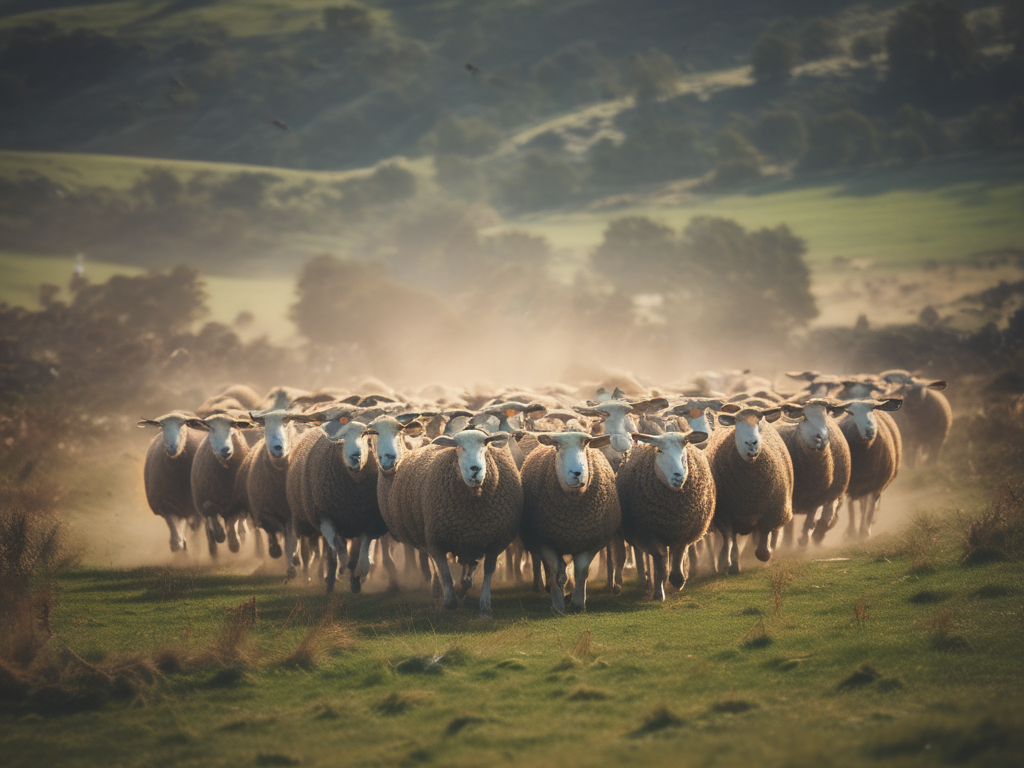
Wyoming was considered to be good grazing land for sheep and often sheep were “trailed” through Wyoming from Oregon through South Pass and down Sweetwater into Carbon County. The bands often had 5,000 to 6,000 sheep each and early sheepmen reported seeing as many as 50,000 sheep in a given day. The dry, cold climate of southwest Wyoming helped to produce aheavy growth of long, fine wool (9).

Early sheep ranchers in Carbon County included the King Brothers and, also, the Cosgriff Brothers. These early sheepmen instituted a system that allowed them to build herds of sheep without investing any capitol called “running sheep on shares.” Many of the early sheepmen of this era built their herds in this way (10). We know Hartt purchased his first sheep from a Frenchman named Revest (11).
An antidote about the King Brothers is that in 1897, there was agitation over a tariff that raised the import tax on woolen goods to 91 cents, called the Dingley Tariff Bill. Australian wool growers felt that U.S.-bred sheep could not produce sheep with comparable quality and weight as their breeds. The King Brothers had a famous exhibition sheep named Ben Hur, a world champion Ramboulillet, whose fleece outweighed the others by several pounds. This evidence went in favor of the Tariff (12).
Many years later, Hartt spoke to his daughter, Marge, of the early days in his career and how range wars impacted the Wyoming sheep industry. Hartt stated: “Oh, they shoved our sheep back into Wyoming a time or two, but that was a long time ago” (13). He also told her about how the sheepmen were sought after by a former Pinkerton detective. This former detective turned out to be Tom Horn, the most notorious of the “regulators” hired to kill rustlers and keep homesteaders off the cattle land. His name “spread terror among the guilty and innocent in 1901” (14). Horn was executed in 1903 for these murders.
Hartt’s experience with Horn may have occurred during his years with either Haley or the King Brothers (1894-1901). We know, for instance, that Judge Lacey presented an affidavit from Ora Haley in the trail that convicted Horn (15). We also see the King Brothers mentioned in Horn’s testimony, as follows:
Q. What people do you refer to?
A. Anybody
Q. The Edward’s, Latham’s and Matheson’s?
A. Yes sir.
Q. You eliminated Wedemier’s, Matheson’s, Kings, Merrifield’s as not much of a place?
A. Is it a sheep range?
Q. The King Brother’s Range?
A. I did not go there (16).

Free land use of the range went to individual ownership in Carbon County in 1901, when the Wool Growers Association began leasing land and issuing permits for its use (17). The years 1895-1910 saw a dramatic increase in the number of “sheep barons”, building on the foundation of the 1880’s and 90’s. It was during this period that great sheep companies were developed in Carbon County. “It was a period in which sheep ruled the land developing fortunes and institutions and the community of Rawlins was destined to become ‘wool famous’” (18).
Introduction: the History of Pearl Lake State Park in Routt County
The Beginning History of Cow Creek and Pioneer Sheep Companies in Wyoming
Exploring the History of Pearl Lake State Park: A Journey Back in Time: Chapter Index
- 1. Introduction: the History of Pearl Lake State Park in Routt County
- 2. The Beginning of the Legacy: Go West, John Kelly Hartt
- 3. The Beginning History of Cow Creek and Pioneer Sheep Companies in Wyoming
- 4. Colorado Cattlemen vs. Cow Creek Sheep: The 1903 Stampede
- 5. A Bride From New England: John Kelly Hartt Marries M. Pearl Hartt
- 6. Sir, They Shot Wilkes Last Night: Life in the Wild West
- 7. Taking the Rap: The Minister’s Son Escapes to Mexico
- 8. The 1910s Tax Dispute: Wyoming Sheep vs. Colorado Cattlemen
- 9. Hartt Family and Sheep Companies at Hahn’s Peak: A Historic Legacy
- 10. Sheep On God’s Mountain: Grassroots Issues
- 11. Hartt’s Business Ventures Expansion in Rawlins | Sheep Business Development
- 12. Family Feuds and Financial Controversies: The Legacy of J.K. Hartt’s Estate in Wyoming
- 13. Pearl Hartt: An Ending Tribute to the Legacy of Pearl Lake’s Namesake
All content in the Exploring the History of Pearl Lake State Park: A Journey Back in Time, including all subsections, are written by Cathy Hartt, granddaughter of Pearl and John Kelly Hartt. Original article written in 2001 with revisions through 2024. Please request written permission for reprints by emailing the author.


 Pearl Lake State Park History